The Ecosystem Study Commission for International Rivers (ESCIR) was established in January 2008 as a non-governmental, non-profit academic research organization and technical platform focusing on sustainable hydropower development on international rivers and is affiliated to CSHE (China Society for Hydropower Engineering). Our 19 members include technical organizations, scientific research institutes, and development enterprises in the field of international hydropower development and environmental protection of international rivers.
Our work is to promote scientific research on the development and protection of international rivers and to maintain the health and sustainable utilization of international rivers. In order to serve the "carbon peaking and neutrality" development of China and the regions where the international rivers are located, we carry our technical research and policy dialogue in the filed of ecological conservation, community development, dam safety and high-efficient consumption of renewable energy, in response to international and regional hydropower development demand by designating “Sustainable Hydropower” and “Carbon Peaking and Neutrality” as our work priority. We also provide technical support to governmental departments on hydropower development and environmental protection on international rivers, as well as business consulting to development enterprises.
We have a wide range of international partners, including the Mekong River Commission (MRC), Asian Institute of Technology (AIT), and National University of Singapore (NUS).
Hydropower is an important renewable energy. It is widely valued by countries for its low-carbon and green power generation, stable and reliable power capacity, and low cost at a time when global energy security is facing challenges. The international community's demand for cooperation in hydropower is rapidly recovering but facing a complex and volatile international situation.
From 2011 to 2021, ESCIR’s main task was to promote cross-border hydropower development and develop sound operation of international hydropower projects. In 2022, bearing in mind in achieving goals of carbon peaking and carbon neutrality and making new advances in international clean energy cooperation, ESCIR adjusted its strategy in response to international and regional hydropower development demand by designating “Sustainable Hydropower” and “Carbon Peaking and Neutrality” as the work priority and conducting technical exchanges and policy dialogue in the filed of ecological conservation, community development, dam safety and high-efficient consumption of RE. Cambodia, as the Chair of ASEAN, and ESCIR jointly held the 2022 Exchange Project of the China-ASEAN Clean Energy Capacity Building Programme in which China not only shared its experience, but also boosted the confidence of ASEAN in sustainable hydropower development.
As a Chinese proverb goes, “the river is wide at full tide; a strong wind sends the sail surging forward”. As we face the crucial stage of achieving carbon peaking and neutrality goals, we embark on a new journey of hydropower cooperation with other countries. And our neighbouring countries are also moving into important stages of implementing low carbon development strategies. Under the guidance of National Energy Administration and Ministry of Foreign Affairs, ESCIR will continue to play our role as a tink-tank in providing policy advice and serving China’s international energy cooperation and an international technical organization in leading technologies and initiatives so as to carry out joint research, exchanges and cooperation and add new splendor to international hydropower cooperation.

Former Deputy Director of the New and Renewable Energy Department of the National Energy Administration of China, Senior Advisor of the China Association for the Promotion of Industrial Development (CAPID)
Deputy Director General, China Renewable Energy Engineering Institute (CREEI)
Senior Consultant, Huaneng Lancang River Hydropower Inc.
Deputy Director, International Cooperation Department, China Renewable Energy Engineering Institute (CREEI)
Deputy General Manager, Huaneng Hydro-lancang International Energy Co.
Deputy Director, System Construction and Operation Management Division of Integrated Basin Monitoring Center, China Renewable Energy Engineering Institute (CREEI)
Wang Bin
Jia Jinsheng, Huang Guangming, Peng Cheng
Gu Hongbin
Zhou Shichun, Guo Jun, Zhou Jian, Yu Weiqi
Wang Bin
Lu Hongwei (Executive), Li Sheng, Gu Hongbin, Huang Guangming
Zhou Shichun
Peng Xin, Guo Jun, Cui Lei
Gu Hongbin
Zhou Jian
Zhou Shichun
Jiang Hao, Wang Hailong
| Bouathep Malaykham | Ministry of Energy and Mines of Lao PDR | Director General of the Department of Energy Industry Safety, Formal Director General of the Department of Energy Management |
| Shobhakar Dhakal | Asian Institute of Technology | Former Vice President, Professor of Department of Energy Environment and Climate Change |
| Su Bin | National University of Singapore | Head of Energy and Environment Division Energy Studies Institute |
| Wang Hailong | Office of the Leading Group on Yajiang Downstream Development, Huaneng Group | Director of Ecology and Environment Department |
| Zuo Hao | China Southern Power Grid Energy Development Research Institute | Deputy General Manager |
| Tian Fuqiang | Tsinghua University | Director, Center for International Transboundary Water and Eco-Security |
| Yan Dong | Huaneng Tibet Yarlung Tsangpo River Hydropower Development and Investment Co. | Party Committee Member, Deputy General Manager/Senior Engineer |
| Li Yungang | Yunnan University | Researcher |
| Yang Hongzhi | Office of the Leading Group on Yajiang Downstream Development, Huaneng Group | Director of Planning and Development |
| Yang Dunmin | PowerChina Chengdu Engineering Corporation Limited | General Manager of International Branch |
| Zhang Guolai | PowerChina Resources Ltd. | Chief Engineer/Senior Engineer (Professor) |
| Zhang Jianli | Huaneng Hydro-lancang International Energy Co. | Director/Senior Engineer (Professor) |
| Lu Bo | China Renewable Energy Engineering Institute | Assistant to the Deputy Director |
| Lu Baohong | Hohai University | Deputy Dean, College of Hydrology and Water Resources |
| Zhou Shichun | China Renewable Energy Engineering Institute | Deputy Director, International Cooperation Department |
| Zhou Heng | PowerChina Northwest Engineering Corporation Limited | Chief Engineer |
| Zhou Haiwei | Hohai University | Dean, Business School |
| Hou Jiangang | Yunnan Huadian Nujiang Hydropower Development Co. | Deputy General Manager |
| Jiang Hao | China Renewable Energy Engineering Institute | Director, International Cooperation Department |
| Gao Caikun | PowerChina Kunming Engineering Corporation Limited | Deputy General Manager |
| Huang Ping | Huadian Tibet Energy Co. | Party Committee Member, Deputy General Manager, Chief Accountant |
| Cheng Hongguang | Beijing Normal University | Dean, College of Water Sciences |
| Fu Ni | CISPDR Corporation | Director, International Engineering and Cooperation Department |
| Xue Lianfang | China Renewable Energy Engineering Institute | Deputy Chief Engineer and Director of Environmental Protection Department |
| Huo Haiping | SPIC Yunnan International Power Investment Co. | Deputy General Manager |
In September 2008, the inauguration and the first working conference of ESCIR under the guidance of China Society for Hydropower Engineering was held in Kunming, Yunnan Province.
In April 2010, ESCIR attended the first MRC Summit held in Hua Hin, Thailand where the heads of Governments of the four MRC Member Countries (Thailand, Cambodia, Laos, and Vietnam) attended and delivered speeches. And China and Myanmar attended the Summit as MRC Dialogue Partners, while Australia, Japan, and other countries attended as Development Partners.
In June 2011, the International Hydropower Association (IHA) held its biannual World Conference on Advancing Sustainable Hydropower in Iguaçu, Brazil, and ESCIR was invited to attend the conference and took part in the launching of the Hydropower Sustainability Assessment Protocol.
In December 2012, ESCIR and the MRC jointly held the 1st Seminar on the LMB Hydropower Development and Environmental Protection Technologies in Kunming. Approximately 100 representatives including officials and experts from National Energy Administration, Energy Administration of Yunnan Province, the MRC, and related countries participated in the seminar.
In November 2012, CSHR approved the reappointment report of ESCIR, followed by the appointment meeting of the second session of ESCIR held in Beijing.
In June 2015, ESCIR and the MRC jointly held the 2nd Seminar on the LMB Hydropower Development and Environmental Protection Technologies in Ho Chi Minh City, Vietnam, with nearly 50 participants from both China and foreign countries.
In December 2017, ESCIR held the appointment meeting of the third session in Beijing, during which the second session’s work report was adopted. The meeting conducted a comprehensive summary of the second session’s achievements in institutional and capacity building, fundamental research on international rivers, international exchange and cooperation, and technical support and services for government departments and enterprises. It also proposed the priority work and annual plan of the third session of ESCIR.
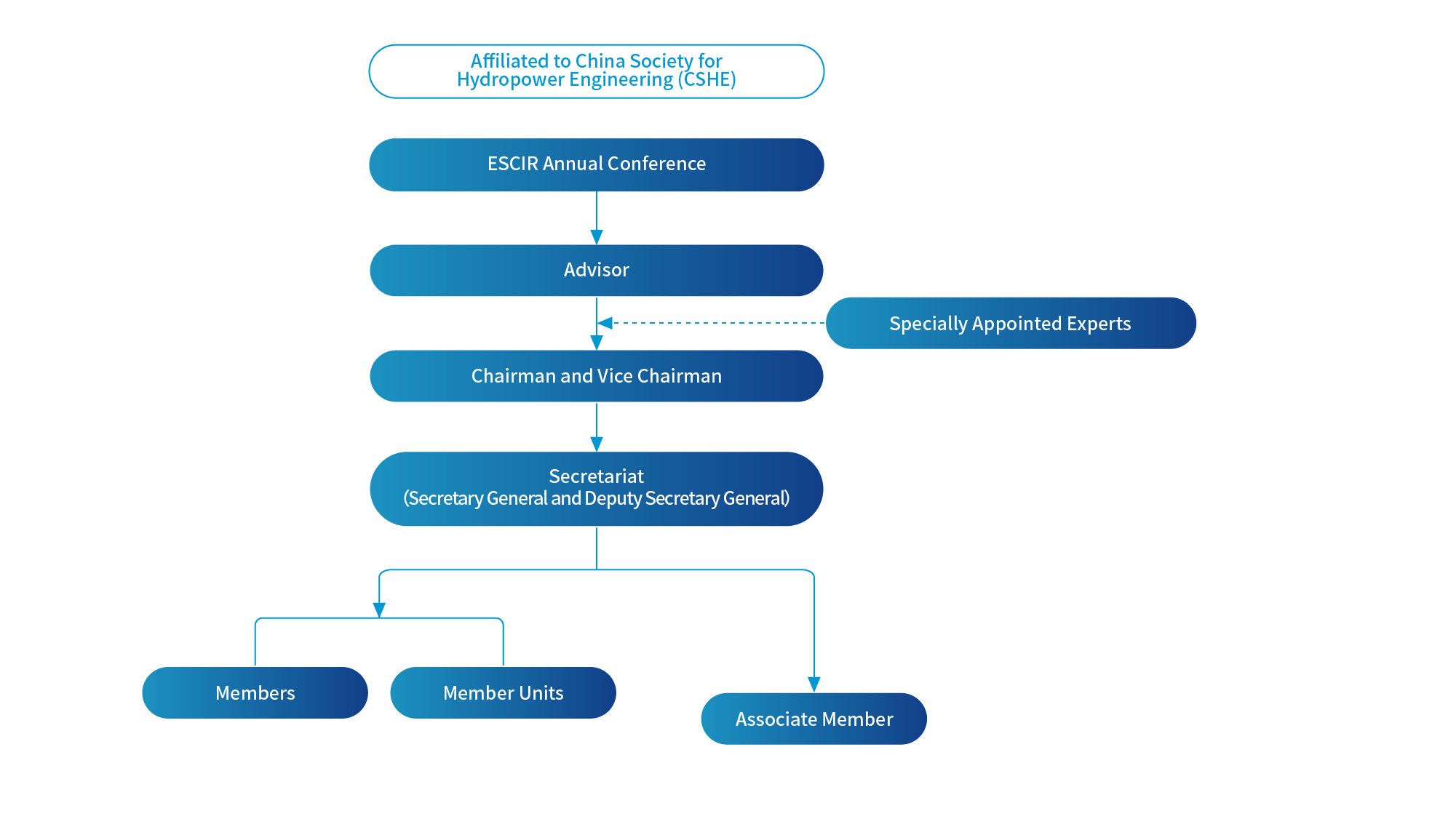
In February 2022, ESCIR held 2022 Annual Conference & Seminar on Policy and Challenges of Cross-border Hydropower Development in the New Era in Beijing, during which the fourth session of ESCIR was elected, including advisor, chairman, deputy chairman, and secretary-general. The Secretariat reported on Recent Developments of the US in the Mekong River and Corresponding Strategies. According to the resolution of the annual conference, the new session of ESCIR designated “sustainable hydropower” and “carbon peaking and neutrality” as the work priority, and would continue to carry out technical research on cooperation for the development of international rivers。